
The technologies behind our services
BioForm Solutions delivers testing through two complementary platforms — flow cytometry for cell health and enumeration, and dPCR for strain identity.
Flow Cytometry
Laser-based single-cell analysis that counts every cell in a sample and resolves live, injured, dormant and dead populations via membrane-integrity dyes — including viable-but-non-culturable (VBNC) cells that plating misses. Same-day results — and never more than 48 hours — with CV < 10%.
Digital PCR (dPCR)
Partitions a sample into thousands of droplets for absolute, single-cell identification — no standard curve required. Ideal for confirming identity and proportions in complex multi-strain blends.
How flow works
Fluorescently-labeled sample cells are suspended in a stream of fluid and passed by lasers which excite the dyes present in the cells. Light scatter is then captured by detectors, allowing the profiling of thousands of particles per second. Analysis of this data determines the health of each cell profile, based on the condition of its cell membrane.
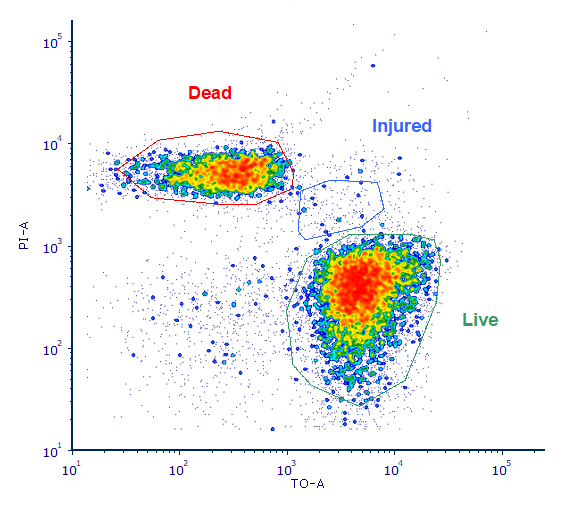
Flow cytometry goes beyond plate counting by providing rich, single-cell data.
Our flow cytometry assays accurately detect the number of live, injured, and dead microbial cells in your products. Label confidently with no more over-filling.
Flow cytometry (AFU)
- Accurately quantifies bacteria—including those with lipid or glycoprotein coatings common to probiotics—without pre-treatment or alteration.
- Detects active, viable-but-non-culturable (VBNC), and postbiotic populations that plating will miss.
CFU plate counting
- Less accurate — detects only colonies that grew on the plate, regardless of how many cells formed each colony.
- Spores must be "activated" in ways very different from how the finished product functions.
- VBNC and postbiotics cannot be enumerated by CFU methods at all.
How dPCR works
dPCR partitions a nucleic acid sample into approximately 20,000 nanoliter-sized water-in-oil droplets, effectively creating thousands of independent PCR microreactors. This massive partitioning ensures that target DNA molecules are randomly distributed, with most droplets containing either zero or a single target molecule.
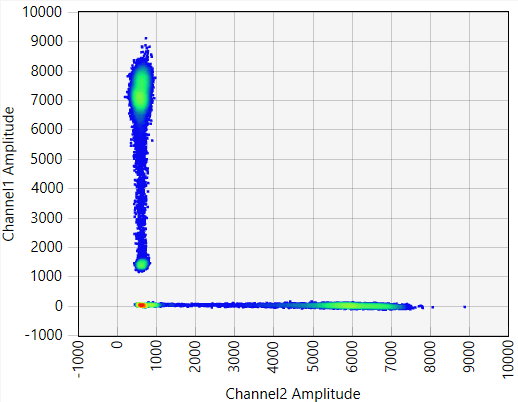
dPCR is superior to qPCR
Absolute, strain-level quantification without a standard curve — the precision to resolve what real-time qPCR cannot.
Digital PCR (dPCR)
- Delivers exact, absolute target counts—no standard curve or reference sample required.
- Offers up to 20x greater precision than qPCR, making it easy to detect rare targets and small concentration differences.
- Less susceptible to sample interference, ensuring reliable results across complex matrices.
qPCR (real-time PCR)
- Relies entirely on a standard curve; overall accuracy is limited by quality of the standard curve.
- Dependent on amplification efficiency and cycle thresholds, which can shift between runs.
- Highly sensitive to sample impurities, which can alter amplification efficiency and skew results.